
Water
Water storage buys the homestead time
Tanks and cisterns decouple pumping from use. They are the physical buffer between weather, power, animals, and the tap.
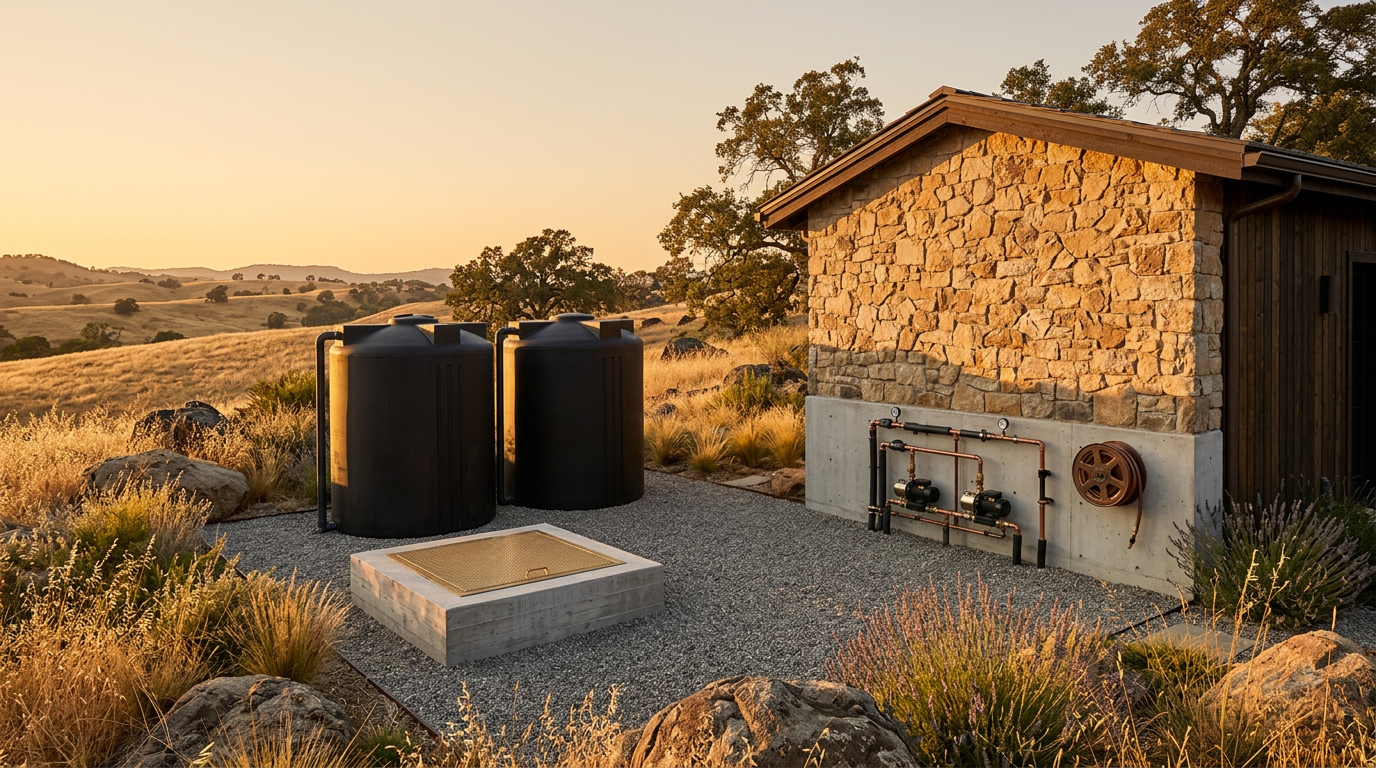
Bad water planning shows up before bad solar planning does.
You can throttle discretionary loads. You can tolerate flaky internet. A building can slip on the calendar. Water does not negotiate. If people, stock, or crops need a pump to fire the instant demand appears, you built a single point of failure and named it convenience.
Tanks and cisterns are not decorative. They are time in cylindrical form.
Insight: Storage decouples pumping from use
The useful mental model is separation.
Without bulk storage, demand and supply move in lockstep. Open the tap, hit the irrigation valve, fill the trough, and the system must deliver pressure now. Pump fault, power sag, well weakness, frozen pipe, or confused controller, and there is no cushion.
Storage inverts the logic. Pump when conditions are good. Draw when you need to. A tank can turn a well pump into a scheduled task instead of a constant companion. It can align pumping with solar hours. It can hold reserve for stock, irrigation, outage, fire prep, or repair.
On a grid-lite site, a few thousand gallons of correctly placed water is one of the clearest resilience moves you can make without a firmware update.
Relevance: A tank touches every other system
The vessel is never only the vessel.
It ties to source, pump, pressure hardware, filtration, frost line, household, greenhouse, irrigation, fire exposure, and how you spend electrons. It might sit above grade, below grade, in a utility barn, uphill for head, or in the line of equipment traffic.
Trade-offs stack fast.
Above-ground: visible, easy to service, often faster to permit and place. Needs freeze strategy, UV discipline, and physical protection. Below grade: steadier temperature, lower visual noise, harder inspection and leak hunt. Pressure tanks tame short cycling for delivery; they are not bulk reserve. Livestock tanks solve daily animal demand and introduce algae, freeze, and contamination questions.
Problems surface late. Level falls slowly until it is suddenly critical. Floats stick. Pumps short-cycle. Buried leaks hide. Troughs freeze while no dashboard asks whether animals can drink.
Monitoring belongs in that gap:
- Visual level marks humans actually read.
- Float switches.
- Pressure transducers.
- Ultrasonic or radar level.
- Flow sensing where it changes decisions.
- Pump runtime trends.
- Freeze and temperature alarms tied to action.
The sensor is a thin layer. The physics and the manual inspection still carry the load.
Ownership: Design for the day the pump does not run
Open with one question: if the pump does not run today, what still works?
House: drinking, sanitation, cooking, hygiene minimums. Stock: trough volume, refill rhythm, winter access. Plants: how long each zone can wait. Fire country: fittings, access, local expectations.
Then work the list:
- Estimate critical daily demand.
- Decide how many days of buffer you are willing to pay for in volume and maintenance.
- Separate potable, irrigation, stock, and emergency paths where codes and hygiene require it.
- Place storage where you can inspect, clean, and repair without heroics.
- Solve freeze before the first hard lesson.
- Add monitoring that triggers a chore, not a chart.
- Keep manual fill, bypass, drain, and isolation paths obvious.
Energy and water meet at the pump. Deep wells often dictate inverter and battery sizing. Pumping into storage on strong solar hours can shave peaks off the electrical story. Gravity or simple mechanical fallback keeps water moving when the electronics are quiet.
The more important a use is, the less it should ride on one clever widget.
Next Action: Draw the water buffer map
Sketch the system as buffers between source and demand.
Left: well, municipal tie, rain, haul, spring, pond, or whatever feeds you.
Right: house, stock, garden, greenhouse, orchard, fire reserve, shop.
Between: pressure tank, cistern, bulk storage, troughs, barrels, emergency totes.
Mark where water sits, where it is measured, and where it can still move by hand.
No buffer between source and demand is the first design problem. Buffer with no state visibility is the first monitoring problem. Sensors with no manual path is the first reliability problem.
Water storage is not interesting because it is complicated. It is interesting because it gives you hours or days to respond instead of minutes to panic.