Monitoring
Homestead sensing beats dashboard theater
Sensors earn their keep when they warn early, stay local, and tie to a real decision. Everything else is decoration.
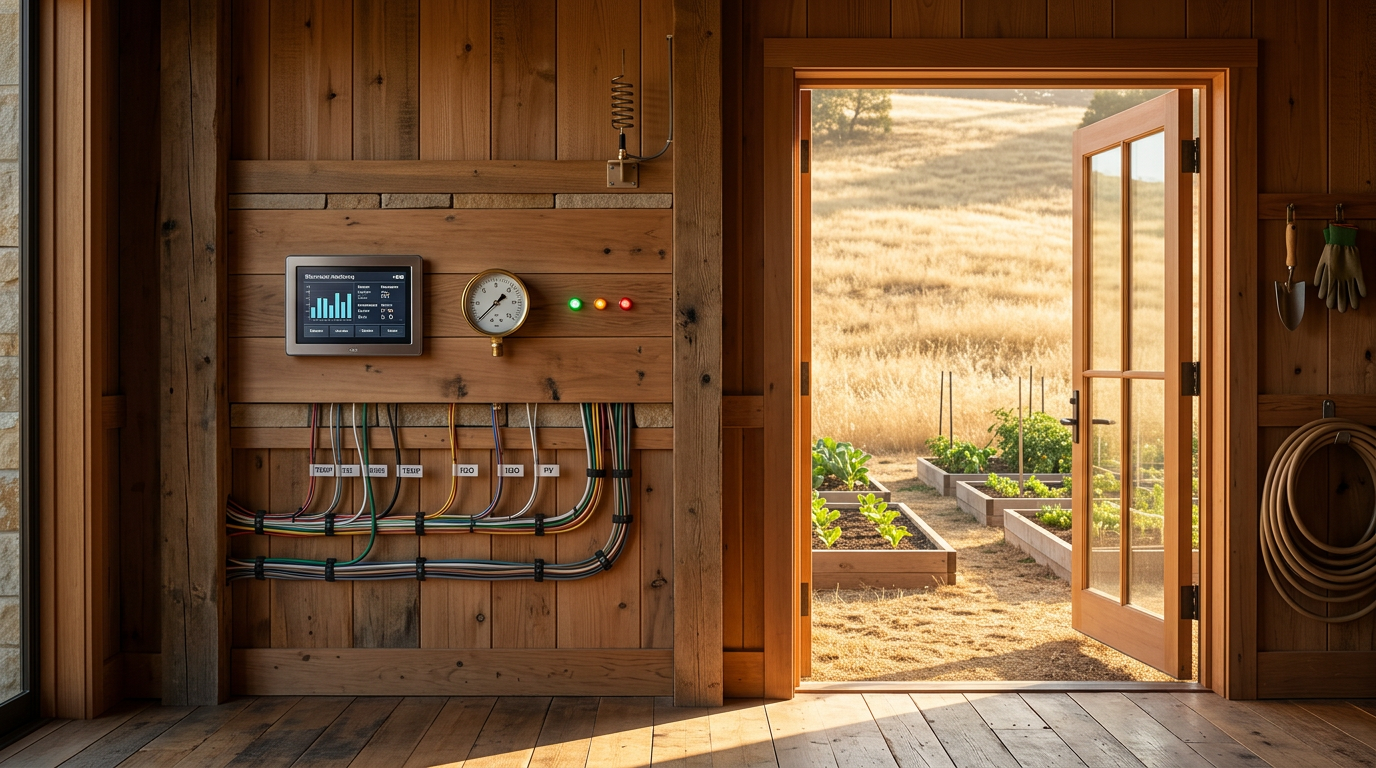
Automation sells faster than monitoring because chores repeat and failures hurt.
On many homesteads the first win is not a smarter actuator. It is earlier signal: tank level, freezer warming, greenhouse heat, a gate that should not be open, a pump that has run too long, a corner of the property drying faster than the rest.
Sensing is the difference between discovering a problem at dinner and discovering it at the end of a hot afternoon.
Insight: The best first system is often an alarm
Consumer smart-home culture treats remote control as the prize. If software can drive it, software should.
Homesteads punish that story. Weather, distance, dust, metal skin on buildings, weak WiFi, cold, mud, and deferred maintenance all favor simple, loud failures over clever silent ones.
A sensor does not have to own a critical loop. It has to surface a condition early enough for a person to act.
Many failures are gradual. A tank falls over hours. A greenhouse climbs in plain sight if you are there, invisible if you are not. A freezer warms after power loss. Soil dries by zone. A pump cycles more often before it seizes. A battery bank trends down before the inverter trips.
The opportunity is not to remove human judgment. It is to give judgment better timing.
Relevance: Acreage hides problems
In a typical house, systems stay within earshot. You hear the appliance, see the leak, feel the room.
Distance changes the model. The barn is not in the hall. The tank sits behind a tree line. The greenhouse drops down a slope. The well house hides around a bend. The back pasture runs a different microclimate than the kitchen garden.
Signals that usually matter:
- Water level in tanks, cisterns, and livestock storage.
- Temperature in freezers, pump houses, greenhouses, and animal shelters.
- Soil moisture in beds, orchards, and exposed slopes.
- Humidity and ventilation in greenhouses, compost, and storage.
- Motion or contact at gates, coops, sheds, and barns.
- Power state for pumps, freezers, inverters, and network gear.
The best sensors are rarely exotic. They sit on systems whose failure creates real work.
Ownership: Design alerts around decisions
Each channel should answer something operational.
Whether the tank is low enough to switch sources. Whether the pump run time is abnormal. Whether the greenhouse is entering the band where ventilation matters. Whether the freezer lost power. Whether the soil is dry enough to irrigate or can wait.
That discipline keeps the stack honest. It stops the dashboard from becoming a hobby detached from chores.
Respect the land in the network design. WiFi works near the house and often fails as a blanket across acreage. LoRa and LoRaWAN move small packets a long way at low power. Meshtastic can backstop weak cellular or build neighborhood mesh. Wired links still belong where reliability beats convenience, especially on fixed infrastructure.
Home Assistant fits technical homesteaders who want local integration. Local-first is not an excuse to build Rube Goldberg on day one.
Start with a few channels. Make alerts legible. Test them while you are home. Only then ask what deserves automation.
Next Action: Install five high-value signals
Fit a first monitoring map on one page.
Pick five:
- One water signal.
- One temperature signal.
- One power signal.
- One security or motion signal.
- One growing-condition signal.
For each, write the action the alert should trigger. No action, no sensor yet.
Then place the signal: WiFi near the house, LoRa for distance, wired for critical fixed gear, or plain inspection where electronics do not justify themselves.
Strong sensing does not make a homestead feel more digital. It makes the place legible under load.