
Food Systems
Food systems work better when the loops are visible
A techno-homestead food system is a set of biological loops. Waste, water, labor, and energy only turn into resilience when the household can see them move.
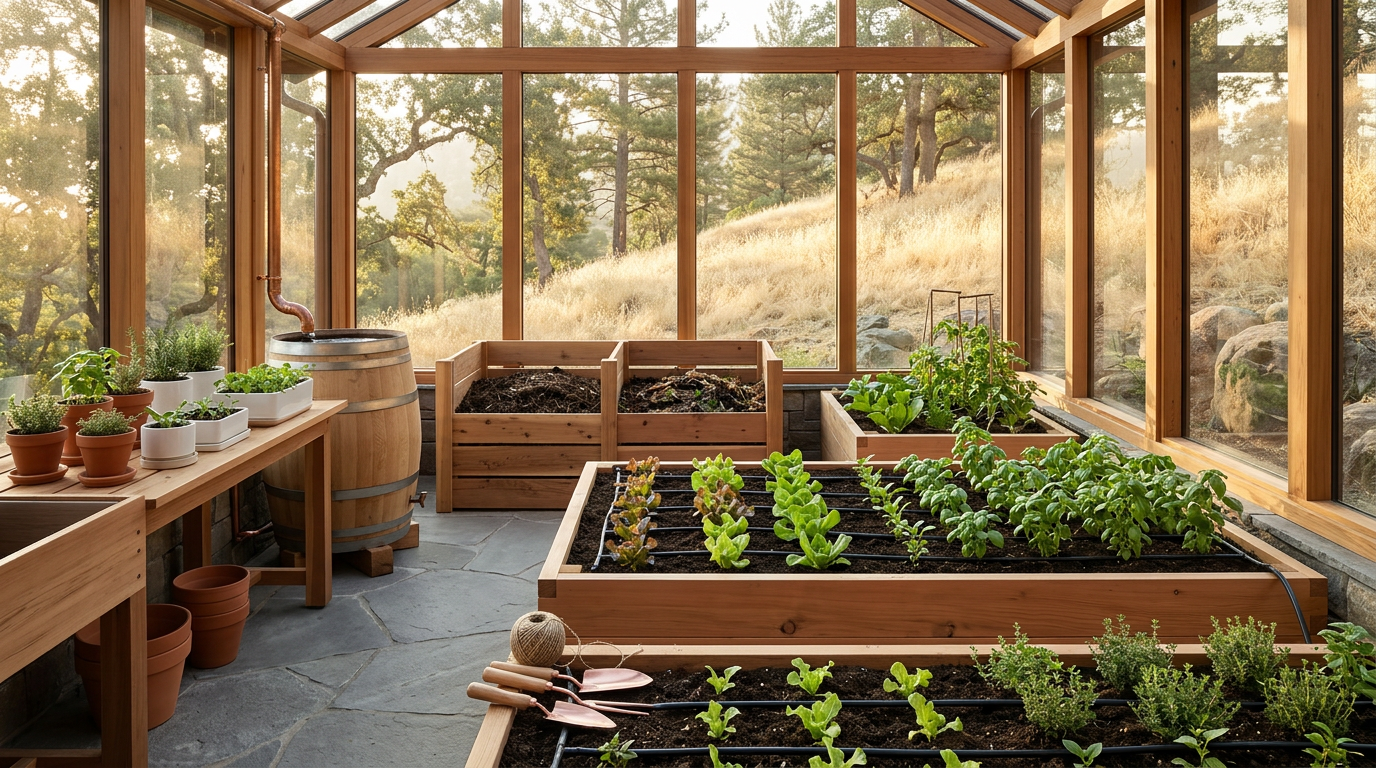
Power systems answer in watts. Networks map to ports. Food systems answer in slow drift: soil structure, pest pressure, a greenhouse that cooks before you notice, a worm bin that goes sour while the surface still looks fine.
Gadgets do not fix that. They make the drift visible earlier, or they add another layer to ignore.
The useful job for technology here is not control for its own sake. It is observation, steadier timing, and enough record-keeping that next season is not a guess.
Insight: A garden is not the whole food system
The usual picture is discrete projects: beds here, chickens there, hydroponics as a weekend experiment, irrigation as plumbing, compost out of sight, spreadsheets never opened.
The sharper picture is a loop.
Kitchen scraps feed worms or compost. Bedding and manure re-enter the pile. Compost feeds soil. Soil grows food. Trim and peelings go back. Water moves through tanks, lines, mulch, roots, and evaporation. Notes turn into patterns. Patterns change when you water, what you plant, and how hard you push the biology.
Techno-homesteading is not about making the garden look futuristic. It is about making the flows obvious enough that someone in a hurry can still improve them.
Relevance: Biological systems fail quietly first
A bed can dry down before the plants advertise stress. A reservoir can leave range while leaves still look fine. A greenhouse can spike in one afternoon. Compost can go anaerobic before anyone wants to stand near it.
For a household juggling animals, water, power, and paid work, those quiet failures cost more than novelty buys back.
Simple signals tend to pay rent:
- Soil moisture in high-value beds.
- Temperature and humidity in greenhouses.
- Water level in tanks and hydroponic reservoirs.
- Timers or zone controllers for irrigation, with override.
- pH and EC where nutrients are in solution.
- Temperature and moisture in worm bins or hot compost.
- Photos and short notes that survive as seasonal memory.
None of that replaces judgment. It buys judgment a little more time.
Food production competes with every other demand on the property. A system that needs perfect daily attention eventually loses to life. Measured inputs shrink that fragility.
Ownership: Automate stability before ambition
The safe automation targets are rarely the flashy ones. They are the ones that keep a living process inside a tolerable band.
Ventilation before heat stress in a greenhouse. Irrigation that holds through dry spells but still yields to a human shutoff. Hydroponics where pH, EC, and volume are watched before any auto-dosing. Compost or worms where moisture and temperature are tracked instead of guessed.
The rule is blunt: automate stability before productivity.
Every food-system automation should answer three questions:
- What condition stays inside range?
- If it fails on, what breaks?
- If it fails off, what breaks?
If either failure mode can kill plants, hurt animals, waste water, or flood a floor, you need a manual fallback or a more conservative design.
Records should stay modest. Planting date, variety, plot, weather note, harvest note, pest pressure, water event, and amendment applied beats a schema nobody maintains.
AI can cluster receipts, photos, and field notes into summaries. It should not become the command layer for living systems. Memory support beats authority.
Next Action: Map one nutrient loop
Pick one loop and draw it.
Start with kitchen scraps. Chickens, worms, compost, landfill? Follow the output. Does it become amendment? Does it reach a bed that produces food? Does waste from that bed return?
Mark the weak points:
- Where the loop depends on memory.
- Where it fails when you are busy.
- Where a sensor would show drift sooner.
- Where automation removes repetition without hiding the process.
- Where the manual path still works.
One honest map beats another smart-garden SKU.
Resilience comes from loops you can tend, measure, and change. Not from electronics sprinkled everywhere.